
Dear Colleagues, Partners & Friends,
Ten years ago, The Fruit Basket began with a simple question: what does it take for an LGBTQIA+ person who has fled danger to be safe in South Africa, and to build a life here?
It is a question we are still asking. The answer, we have learned, is bigger than just a place to sleep.
South Africa is one of the few countries on the continent that protects the right to seek asylum for those who find themselves displaced and/or persecuted on grounds of sexuality, gender identity or other humanitarian crises. However, this system is flawed when compared to the global approach to the asylum model. Yet gaps in documentation, healthcare, housing, legal support and livelihoods leave grassroots organisations to bridge the divide, a responsibility best carried by a strong network, not any single organisation.
When we think about safety for our community it can mean a number of things. It can mean holding the right documents, having access to legal support that is sensitive to your circumstances, accessing healthcare without fear, developing the skills to earn a living, finding somewhere safe to stay, or simply having someone listen and help you work out what comes next.
For ten years, The Fruit Basket has been a part of that process supporting LGBTQIA+ asylum seekers, refugees, and migrants in crises.
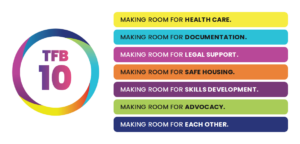
Today, our work spans five areas: documentation, legal support, health and wellbeing, skills development and accommodation. Some of this support is delivered by our small team and some through trusted partners. We are committed to providing support across our five areas of work, either directly or by connecting people with trusted partners and services when we cannot provide it ourselves.
In each of these areas, we have learned something, and we are changing how we work.
Documentation: expanding our network of specialist organisations to strengthen support with asylum applications, passports, relocation pathways and other essential documentation.
Legal support: expanding formal partnerships with law clinics and legal practitioners to improve access to legal advice, representation and support with asylum, immigration and other legal matters.
Health and wellbeing: more and stronger formal partnerships with gender-affirming care and dedicated psychosocial support, as global funding cuts have made already limited health services even harder to reach for the communities we serve.
Skills development: moving to a structured programme that supports economic independence through employment, self-employment, and entrepreneurship, covering practical, professional, job-search and interview skills.
Accommodation support: the past three years have taught us particularly important lessons about housing. The Safe House has provided something invaluable to many people: a bed, a community, and a place to breathe when life has become uncertain.
We are proud of that work. We have also learned that one house cannot meet every need.
Living together can bring challenges around privacy, as well as security issues and can only accommodate a limited number of people. Sometimes what someone needs is not only shelter but help with a month’s rent, support through an immediate unsafe situation, or skills training to find a more sustainable way to self-sufficiency.
We have also learned that offering support is not enough. We have to know if that support is reaching people in the way we intended. There have been times when the services we described were not delivered as consistently as we wanted them to be. We have taken that seriously. We are strengthening our needs assessments, case records, referral pathways and follow-up processes so that support is clearer, more consistent and easier to track and account for.
We are evolving.
The lessons of the past ten years have shown us we can go further.
This is why alongside a smaller Safe House, we are developing a Safe Rooms model through screened hosts and accommodation partners, connected to the wider support we provide around documentation, health, skills and legal needs. Together, our limited transitional accommodation and Safe Rooms model provide temporary, individualised support while people work towards greater stability and independence.
This is about building capacity in how we deliver support, not abandoning temporary housing.
Our ambition is to build something more flexible, private and capable of reaching more people, also outside of Johannesburg.
We recognise that this change affects people who have made the current Safe House their home, and that moving can bring uncertainty and distress. We have spoken with residents about the transition and are working with each person on practical next steps, including time-limited accommodation support, referrals and other support based on their circumstances. We will listen to concerns, address them directly and manage the transition with care for each person’s safety, privacy, dignity, and agency. Ten years gives an organisation enough history to know that it will not get everything right. It also gives you enough history to know why we keep going.
The global landscape has changed. The needs around us have changed. The funding landscape has changed. Our understanding of this work has changed. And we expect all those things to keep changing.
What has not changed is the reason we exist: to support LGBTQIA+ refugees and displaced people to find safety, support and the possibility of building a life in which they can determine what comes next.
Over the coming months, we want to share more of our story, the people and partnerships behind the work, what we have learned, what we are changing, and what we hope to build in the future.
Ten Years is not the end of this story. It is an opportunity to ask better questions. We are making room for the answers.
In solidarity,

Thomars Shamuyarira
Director
The Fruit Basket
Never Miss News